



Celebrating 22 Years in Practice
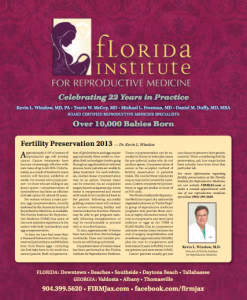 Kevin L. Winslow, MD, PA
Michael L. Freeman, MD
Daniel M. Duffy, MD, MBA
Board Certified Reproductive Medicine Specialists
Over 10,000 Babies Born

Request an Appointment by Phone or In-Person
Call (904) 399-5620 - (800) 556-5620
Weekend Appointments Available
Kevin L. Winslow, MD, PA
Michael L. Freeman, MD
Daniel M. Duffy, MD, MBA
Board Certified Reproductive Medicine Specialists
Over 10,000 Babies Born
FREEZING EGGS NO LONGER EXPERIMENTAL
63 Babies Born – Florida Institute for Reproductive Medicine
The American Society of Reproductive Medicine recently removed the label “experimental” in describing egg freezing. To date over 4000 babies have been born from frozen eggs, health data on these babies has been extremely reassuring. Pregnancy rates using cryo eggs have continued to improve now approaching those from frozen embryos. Egg freezing offers tremendous advantages to at least three groups of women: those faced with losing their fertility due to cancer treatment or surgery, women who for whatever reason must postpone childbearing late into their 30s or beyond, and patients requiring in vitro fertilization who are ethically opposed to freezing embryos. While ASRM has not endorsed the use of egg freezing for delayed childbearing, we at the Florida Institute for Reproductive Medicine feel it is an appropriate option for those who otherwise would have little chance of having their own genetic children later in life. At the Florida Institute for Reproductive Medicine, Dr. Yang has pioneered the technology of oocyte cryopreservation, we have had one of the largest experiences in the United States with sixty-three babies born, including the first baby born in the world to a cancer patient who froze her eggs. Again our follow up health data on these babies has been reassuring. I do advise couples that the ultimate health testament will be when children born from frozen eggs have had their own healthy children. We hope by lifting the label of experimental, insurance companies will consider covering egg preservation for at least those women faced with sterilizing. The technique of egg freezing involves going through an IVF cycle, costs are almost identical, approximately $10,000.00 to $12,000.00 depending on the amount of medicine used. The Florida Institute for Reproductive Medicine has participated with a national group, Fertile Hope, in providing significantly discounted costs for egg freezing for cancer patients. Ferring pharmaceuticals has been extremely generous in donating medications saving patients as much as $3,500.00. We welcome ASRM’s recent opinion on egg freezing and hope many other women will be able to avail themselves of this remarkable technology.
Don’t be misled by statements reporting we have the largest IVF, donor egg IVF or gestational surrogate IVF program. The truth is that what is often being represented is far from what you’re probably interested in. Ask specific pointed questions, i.e. how many IVF pregnancies have come from your current lab, not another lab or program that you may have participated in the past. Ask what the take-home pregnancy rate is, be careful to also ask how many total IVF cycles have been performed to get an idea of the programs experience. Ask for official CDC pregnancy results in writing (http://www.cdc.gov/art/). Ask who the lab director is, is the director a doctoral level embryologist? Has the director obtained the certification of highly complex lab director? Has the director been involved in any original reproductive medicine research? At the Florida Institute for Reproductive Medicine we have had over 4,000 babies born from our IVF program over the last twenty years. Our pregnancy rates have consistently been in the top ten percentile nationwide. We have accounted for 87% of all IVF pregnancies, 83% of all donor egg IVF pregnancies and 99% of all pregnancies from cryo eggs over the last ten years in the North Florida/South Georgia area. Our embryology team consists of three doctoral and one master’s level embryologists, headed by Dr. Yang. Dr. Yang has over twenty years of embryology experience; he holds the certification of highly complex lab director. Dr. Yang is world renowned for his original research regarding intracytoplasmic sperm injection/IVF, as well as his work on egg freezing.
We are pleased to announce Florida Institute for Reproductive Medicine is now one of a select group of IVF programs in the nation now offering Day 5 Laser Embryo Biopsy. This technology allows for the laser extraction of multiple cells from a day 5 embryo to test for genetic normalcy prior to transfer. Prior day 3 embryo biopsies where only one or two cells were available for testing has been shown not only to be inaccurate, but to compromise implantation rates. Day 5 embryo biopsy has tremendous implications in terms of avoiding multiple births, i.e. with accurate pre-embryo genetic screening ongoing pregnancy rates of 60-70% have been reported with a transfer of a single chromosomally normal embryo. Because the majority of pregnancy losses are due to chromosomally abnormal embryos, this technology is expected to significantly reduce miscarriage rates. The cost for this service will range from $2,500.00 to $3,000.00 depending on the number of embryos biopsied. We expect these costs to be recouped by avoiding freezing and transfer of abnormal embryos. By avoiding multiple births with their inherent risks and costs, we have eliminated the greatest problem associated with IVF. If you are interested in learning more about this technology, please make a consult appointment with one of our physicians.
Most patients know not to smoke, don’t they? Maybe so, but that doesn’t mean that they (and their partners) don’t smoke, or that they tell the truth to their doc, or that they aren’t exposed to significant amounts of secondhand smoke.
Approximately 30% of reproductive age women and 35% of reproductive age men in the United States smoke cigarettes, as do an increasing percentage of adolescent and teenage girls. This is despite costly and long-standing national campaigns to limit their use.
Given the high prevalence of smoking and the documented variety of deleterious health effects, C. Everette Koop, MD, the former U.S. Surgeon General had appropriately labeled smoking “the chief single avoidable cause of death in our society and the single most important health issue of our time.” Specifically addressing the adverse effects of smoking on reproductive health in the introduction to a Seminars in Reproductive Medicine issue devoted to a review of the this subject , Dr. Koop summarized the available data in stark terms: “Women who smoke have decreased fertility. The risk of spontaneous abortion is higher for pregnant women who smoke… Babies born to smokers weigh, on average, 200 grams less than babies born to comparable women who do not smoke, with low birth weight being an important predictor of infant mortality”
In addition to smokers who inhale the toxic, carcinogenic and mutagenic substances known to be prevalent in cigarette smoke, many nonsmokers are regularly exposed by inhalation of “sidestream” smoke from burning cigarettes and / or from “passive” smoke exhaled by smokers. A recent study documented cotinine, a major metabolite of nicotine, to be found in dose dependent concentrations relative to the number of cigarettes smoked in 100% of the follicular fluids of infertility patients undergoing in vitro fertilization oocyte retrieval. One hundred percent (100%) of women known to be exposed to passive smoke in the home also had follicular fluid cotinine detected, albeit at lower concentrations. What was as alarming was that 84% of women reporting themselves as non-smokers and with a non-smoking partner also had detectable levels of cotinine in their follicular fluids. These women were exposed environmentally, with all but one working outside the home. As the authors, who had previously reported the ovarian toxin heavy metal cadmium in the follicular fluid of smoking infertile patients, state regarding these women, “this constitutes an unsolicited hazard to their health and is an argument for smoke free public areas and workplaces.”
A number of comprehensive reviews of the literature have been published summarizing the cumulative data supporting an association between cigarette smoking and diminished female fecundity. The impact of cigarette smoking on early spontaneous abortion has been an important addition to these reviews on fertility, with the increase in pregnancy loss and ectopic pregnancies attributable to smoking adding to the overall adverse reproductive impact of this habit. It has led Joffe to describe smoking as the foremost reproductive poison of the 20th Century – and, might we add, perhaps the 21st.
Augood estimates that up to 13% of female infertility is caused by cigarette smoking.
The available biologic, experimental and epidemiological data support a substantial increase in female infertility attributable to cigarette smoking. Stopping smoking in many women not already in earlier menopause and not permanently effected with tubal factor infertility returns the potential for fertility. Ex-smokers have fecundity similar to that of women who have never smoked, often when they quit even within a year of starting to try to conceive. The adverse effects of sidestream and passive smoking are notable and add to the urgency of addressing not only those who smoke in campaigns aimed at prevention of infertility, but those with whom they live and work or share the environment.
Those couples already suffering from infertility need to know that continuing to smoke adversely effects the success of therapy. In particular regarding Assisted Reproductive Technology (e.g. in vitro fertilization therapy), ovarian reserve, ovarian response to stimulation, the number of oocytes retrieved and fertilized, and the pregnancy rates are reduced in smokers compared to non-smokers.
The pregnancy rate in in vitro fertilization treatment cycles was thus reduced in smokers by 34%. The deleterious effect of smoking becomes more detectable in older women undergoing therapy. The percentage of women experiencing conception delay for over 12 months was 54% higher for smokers compared to non-smokers. Exposure to passive smoke further increased the odds against a woman conceiving within 6 months. Smoking by the mother, the father, or other exposure to tobacco smoke were all associated with a longer time to conception.
This information may help those seeking to conceive and carry a healthy full-term infant to do so by imploring them to stop, especially those already having difficulty conceiving or maintaining a pregnancy. And for those not currently seeking to conceive but with wishes and dreams for the future, if they are in need of yet one more health risk to add to the panoply of reasons to discontinue their habit or never start, this information and data may be most useful in the prevention of infertility.
The good news is the ready availability of evidence-based Smoking Cessation Guideline materials for health care professionals and the public, including beneficial brief interventions designed for the busy doctor’s office. First developed in 1996, the Guideline is updated regularly.
See www.surgeongeneral.gov/tobacco/default.htm.
ACOG also has material at www.acog.org/departments/dept_web.cfm?recno=13.
And the American Cancer Society has Great American Smokeout aids at www.cancer.org.
Approximately 40% of infertility is related to the female, 30% to the male – in 20% there may be a combined problem (10% of infertility is unexplained). For that reason patients are encouraged to come in as a couple to review both partners’ history. The female history will focus on the menstrual cycle, which gives a good idea as to whether ovulation may be the issue, as well as surgical and infectious disease history that may point to an anatomic problem. The male history will focus on problems that affect sperm production, i.e. surgeries, infections, adverse environmental exposures. A good history from both partners will go a long way in identifying a probable cause(s).
Generally, a physical exam is not performed on the first visit unless there is something which clearly points to an anatomic problem, i.e. fibroids tumors, ovarian cyst, or very low sperm count. In the case of a female anatomic problem most often a vaginal ultrasound will be performed to visualize the uterus and the ovaries. If a male anatomic problem is suspected, an exam of the testicles and phallus will be performed.
If ovulation is a problem, most often an endocrine panel will be drawn to determine the cause. This will help determine the most appropriate fertility medication. If the female history points to an anatomic problem most often a hysterosalpingogram or laparoscopy will be ordered. A hysterosalpingogram is an outpatient procedure performed in radiology whereby the physician injects a radio opaque dye through the cervix and can look at the contours of the uterine cavity as well as determine tubal patency. A laparoscopy is an outpatient surgical procedure performed under general anesthesia. If pathology is found laparoscopic operating instruments can be introduced to correct the problem.
If a couple has already had a complete work-up and there is a clearly identified cause(s) for infertility an immediate treatment plan will be outlined. At the Florida Institute for Reproductive Medicine we will review costs of tests and treatments and will check with your insurance company to determine coverage.
Have you thought about in vitro fertilization but are concerned about the investment? The Florida Institute for Reproductive Medicine offers a package of three fresh IVF cycles as well as the transfer of all cryopreserved embryos. This package includes intracytoplasmic sperm injection as well as assisted hatching if indicated, and it includes cryopreservation of embryos if available. Completion of all fresh and cryo IVF cycles must occur within a sixteen month period. Transfer of all cryopreserved embryos must occur before another fresh IVF cycle is begun. Cost for this package is $14,500, not including the cost of fertility medications. Medication costs range from $2,600 to $4,000 depending on patient’s age, weight and ovulatory status. There are no refunds whether pregnancy occurs before three completed fresh cycles or before completion of all cryopreserved embryos.
Although this program is available to anyone, this program is ideal for patients with a lower than optimal probability of success. When one considers the high pregnancy rates at the Florida Institute for Reproductive Medicine for both fresh and frozen embryos (http://www.cdc.gov/art) we believe this package may represent the best IVF values in the country.
Diagnosis and treatment of infertility is expensive. Unfortunately most insurance companies continue to look at infertility as an elective part of health care – frequently not covering diagnostic testing or treatment. Infertility costs for the most common treatment (i.e. ovulation induction with washed intrauterine insemination) ranges between $500 – $600 at the Florida Institute for Reproductive Medicine. Costs for in vitro fertilization, range between $10,000 – $11,000. In general, we want to try the simplest therapy that has a good chance of working, give it a good try; and if it is not successful, move on to more aggressive options.
The Florida Institute for Reproductive Medicine has partnered with a finance company to provide financing of infertility care. Rates as low as 3.99% are available for individuals with good credit. Loans from $2,000-$40,000 are available with payments ranging from 24-84 months. No up-front payments are needed. There are no pre-payment penalties. The Florida Institute for Reproductive Medicine has an assistance program for our IVF patients who have no insurance coverage and who qualify based on income, whereby up to $2,000 worth of medications will be provided. We have a 10% discount for all active military patients.
Some more creative options couples may consider include:
Above all, do your homework. At the Florida Institute for Reproductive Medicine we have always strived to offer the best treatment value for all our services. Our pregnancy rates have been consistently amongst the highest in the country. Costs for all our services at the Florida Institute for Reproductive Medicine typically range 25-30% less than national averages.
The ability to freeze a human egg offers at least two important options for women: fertility preservation for women faced with potentially sterilizing therapies and individuals postponing childbearing, as well as couples requiring in vitro fertilization (IVF) who are ethically opposed to freezing (pre)embryos. Being able to freeze eggs also allows for the establishment of egg banks, greatly improving the efficiency and lowering costs for donor egg IVF.
We have been able to freeze (pre)embryos since the early 80’s, a technique that is routinely performed in most reproductive medicine programs. Freezing an unfertilized egg is much more difficult because of the large size and water content, i.e. as the egg cools ice crystals develop which can damage the working components known as organelles. When a (pre)embryo is frozen, the essential task of these organelles has already been performed.
The first pregnancy from a frozen egg was achieved by Dr. Chen in 1986. Following this pregnancy there were no other pregnancies until the early 90’s. With the abolishment of (pre)embryo freezing by the Italian government there was a resurgence in egg freezing technology. Dr. Borini and others refined the protocols for egg freezing, and with the advent of intracytoplasmic sperm injection (ICSI), whereby a single sperm could be injected into an egg the efficiency of egg freezing increased. Dr. Dunsong Yang, the head of embryology at the Florida Institute for Reproductive Medicine, was one of the early pioneers in refining the egg freezing protocol, greatly improving its efficiency.
The Florida Institute for Reproductive Medicine has one of the largest experiences with egg freezing in the nation with over 63 babies born, including the first baby born in the world to a cancer patient who froze her eggs prior to chemotherapy. Currently we are seeing pregnancy efficiencies of approximately 10 eggs equating with an ongoing pregnancy for egg donors 35 years or less and approximately 14 mature eggs for those 36-38 years of age. In general, we do not freeze eggs beyond 38 because of the high percentage of abnormal eggs. Our work on egg freezing has been chronicled in People, Self, Pink, Conceive, and Woman magazines as well as on CBS, NBC, BBC News, and the Today Show.
To date, in the world there are approximately 3,000 babies born from frozen eggs. Health data on these infants continues to be very reassuring. Until, however, high numbers of these children have reached adulthood and reproduced, the absolute safety of this technology cannot be asserted. For that reason egg cryopreservation is still recommended to be done under an IRB (institutional review board) approved protocol. At the Florida Institute for Reproductive Medicine we keep yearly surveys of our cryo egg births through annual questionnaires to parents and pediatricians. Costs for egg freezing at the Florida Institute for Reproductive Medicine mimic those of an IVF cycle, i.e. approximately $10,500.
We will store eggs at no charge for a period of five years, after that time there is an annual storage fee of $400. For our cancer patients seeking fertility preservation, we have been able to get medicines donated by the Ferring drug company, saving patients approximately $3500. The longest an individual has stored eggs to date and had a successful pregnancy is 6 ½ years. We do not believe there likely is a shelf life to frozen eggs.
Approximately 10% of women who undergo tubal ligation subsequently wish to have another child – the most common reason being a new male partner who has never fathered children. Tubal ligation involves the interruption of the tube, typically in the mid portion or rarely resection of the distal end of the tube. All tubal ligation patients have the option of in vitro fertilization (IVF), assuming they have good ovarian reserve, i.e. a reasonable number of good quality eggs left in their ovaries. Ovarian reserve can be checked by a variety of means, the most accurate being an ultrasound count of follicles in the ovary along with a blood test known as antimullerian hormone level.
To be a candidate for tubal reconstructive surgery it must be ascertained that the patient has sufficient healthy remaining tube and that the distal working end of the tube has not been removed or damaged. If a tubal ligation has been performed using cautery often extensive tube damage has occurred. These individuals in general are not good candidates for surgery. Prior to considering tubal surgery a semen analysis to rule out a severe male factor should be performed. If a severe male factor is found, IVF using intracytoplasmic sperm injection (ICSI) is likely to be the best option.
If the female partner is older than 35, despite good ovarian reserve she is likely to have an increased proportion of poor quality eggs, often resulting in a significant delay to conception. For the older patient IVF is likely to be the preferable option. If ovarian reserve is poor, donor egg in vitro fertilization is the most realistic option. If the female partner is 35 years or less with good ovarian reserve pregnancy rates of approximately 70% can be expected with surgery, comparable to cumulative pregnancy rates with IVF.
At the Florida Institute for Reproductive Medicine tubal reanastomosis is being performed on an outpatient basis with the use of the da Vinci robot allowing individuals to return to work typically within one to three days. Surgery is associated with a significant increase in the risk of an ectopic pregnancy, i.e. a pregnancy getting “stuck” in the tube. This condition can be serious requiring emergent surgery. If a couple decides they only want a single pregnancy the issue of future contraception must be addressed. At the Florida Institute for Reproductive Medicine, using the robotic laparoscopic approach we are able to offer this surgery at a cost of $6,750 (cost for an average IVF cycle is $11,000). The primary disadvantage of IVF is a high multiple pregnancy rate. For individuals less than 38 years of age multiple pregnancy rates range from 20-40%, 98% of these being twins. While the great majority of twins do very well there is an increased risk of morbidity and mortality. Almost all multiple pregnancies are delivered by cesarean section. The issue of a multiple pregnancy can be avoided by electing to transfer a single embryo. For couples who are ethically opposed to IVF because of the issue of freezing (pre)embryos, this can be avoided through egg freezing. Because of the disadvantages associated with surgery approximately 9 out of 10 couples at our center are electing IVF as opposed to surgery. With the advent of the low cost outpatient robotic approach, we believe this ratio will decrease.
There are not enough words to say to tell you how much we LOVE and appreciate you. You are truly a God send and I’m so grateful our paths crossed. I never imaged I would be one of the many people who suffered with fertility issues but after years of trying with no success and […]