





What treatments are available for uterine fibroids?
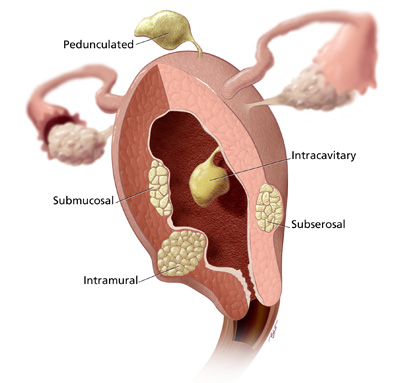
I previously discussed the impact that fibroids can have in a woman’s life, primarily that of irregular bleeding, pelvic pain, and infertility. There are various options for the treatment of fibroids depending on the future fertility plans of the woman. The guiding question should be whether or not there is or may be any future plans to conceive. If so, then the only treatment that should really be considered is a myomectomy, a surgical procedure in which the fibroids are removed, leaving the uterus in place. If childbearing is complete, then there are several other routes which may be chosen. These could include a myomectomy, hysterectomy, uterine artery embolization, endometrial ablation, or MRI guided focused ultrasound.
Medical (Non-Surgical) Management of Fibroids
I did not mention the use of medications in the above paragraph due to the fact that this is not a good long term option for fibroid treatment, and is only used in a few circumstances. The medications that are used work by shutting down the ovary temporarily. This induces a temporary reversible menopause-like situation. This can be used to reduce bleeding due to fibroids, and help to shrink them by about 30%. However, this effect only lasts as long as the medication is used, with fibroids returning to their normal size soon after stopping the medication. Due to the menopause-like situation, this treatment should only be used for short term treatment (<1 year duration) with ultimate definitive therapy. This is most frequently used in women who are having heavy bleeding, allowing the bleeding to slow or stop down so that her body can recover before ultimately having surgery.
Myomectomy
In a myomectomy, uterine fibroids are surgically removed, leaving the uterus in place. If fibroids are located primarily within the uterine cavity (submucosal type), then they may be able to be removed with a hysteroscope (small camera) by entering the uterus through the cervical opening. In most cases, they are removed by making an incision on the outside of the uterus, removing the fibroids, and suturing (sewing) the uterus back together. In the past, myomectomies were performed through large open incisions in the abdomen, often going side-to-side, but sometimes vertically. This type of “open” myomectomy has significant drawbacks, including a 2-3 day hospital stay, extended recovery, adhesion (scar tissue) formation, and significant blood loss. In recent years, there has been a large shift towards performing myomectomies by laparoscopy (through small incisions using cameras). This “minimally invasive” route offers significant advantages, including less pain, a more cosmetic result with smaller incisions, usually no overnight hospitalization, less bleeding and scar formation, and a much faster recovery. Before a few years ago, only some selected cases were performed laparoscopically due to the significant increase in difficulty in performing myomectomies laparoscopically. The introduction of the da Vinci Robotic System for laparoscopic assistance has made a tremendous improvement, allowing nearly any myomectomy to be performed laparoscopically, regardless of size or difficulty. Our practice specializes in myomectomies and is able to repair and reconstruct the most severely distorted uterus due to fibroids.
Hysterectomy
For some women, they may choose to have a hysterectomy (removal of the uterus) as a treatment for fibroids. It is for this reason that a hysterectomy has become one of the most common surgeries that a woman may face during her lifetime. Most hysterectomies can be accomplished by a minimally invasive route, either removing it through the vagina, or laparoscopically through the use of small cameras, or in difficult cases, using Robotic assistance to perform it through a camera. Rarely is an open incision needed for a hysterectomy.
Uterine Artery Embolization
A uterine artery embolization (UAE) procedure performed by a specially trained radiologist which involves injecting small particles (about the size of a small grain of sand) into the uterine blood vessels. These particles clog the small blood vessels that supply the fibroids, cutting down the blood supply and causing the fibroids to die and degenerate. Fibroid volume shrinks by 40% to 50%, and the majority of patients experience symptomatic relief. However, patients generally experience several days of pain after the procedure and are usually hospitalized for 1-2 days. Women who are older may at risk of developing early ovarian failure. Due to the effect on uterine blood flow, this technique is not recommended for women who would like to conceive in the future, and for those who do, there is a slightly higher rate of pregnancy complications.
Endometrial Ablation
An endometrial ablation is a procedure that is intended to treat heavy uterine bleeding in general. This could be due to fibroids or to other causes. In this procedure, one of several techniques are used to basically burn or cut out the endometrium (lining of the uterus). This significantly limits the amount of bleeding that occurs. An ablation may be effective in treating bleeding due to fibroids, but may often provide only effective treatment for a limited time (perhaps 1-3 years). Bleeding may return as fibroids continue to grow and enlarge.
MRI Guided focused ultrasound
This is a newer approved technique which uses powerful ultrasound waves to destroy the fibroid. It has only limited availability, and only small studies available with long term follow up. It is likely most effective for someone with a small number of larger fibroids. However, due to the lack of long term follow-up results it is not widely recommended and cannot be recommended for anyone wishing to retain their fertility.
In summary, if fertility is still desired, then a myomectomy is the procedure of choice. Other forms of fibroid treatment should not be undertaken due to known problems with subsequent pregnancies. If childbearing is not desired, then the woman can make an informed decision with her physician regarding her desires, knowing that each of the above option has both benefits and drawbacks.